


COMUNICACIÓN
Experts and Students at Campus Yuste Reflect on Relaunching Euro-Latin American Relations
News
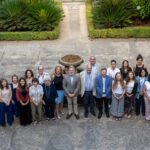

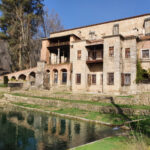
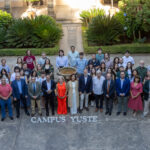
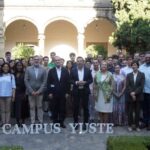
 The European and Ibero-American Academy of Yuste Foundation aims to contribute to the promotion and consolidation of existing ties between Extremadura, Europe, and Ibero-America. In line with this goal, the Foundation organised the course “European Union-Latin America and the Caribbean Relations: New Times and Renewed Commitments” along with the EU-LAC Foundation in order to analyse “how to strengthen relations between these two regions to promote multilateralism and combat the challenges that constantly threaten us, with the aim of strengthening our democracies and creating certainties”. This was stated by Pablo Hurtado Pardo, director general of External Action of the Regional Government of Extremadura and member of Yuste Foundation’s board of trustees, during the course’s inauguration. (23/07/2024).
During his speech, the director general explained that the Monastery of San Jerónimo de Yuste, and consequently Yuste Foundation, have become a centre for the defence of values and a space for the memory, study, and calm reflection on the relations between the European Union and Latin America and the Caribbean. He emphasised that “the only way to move forward and respond to our societies is to deepen the horizontal and symmetrical conversation between our regions because we share challenges and problems, but we must also share solutions”.
The European Union and Latin America and the Caribbean are united by history, culture, language, and affections. Therefore, according to the director general, “we must rethink our common strategy by becoming strong allies in this new geopolitical context”. Similarly, the director of Yuste Foundation, Juan Carlos Moreno Piñero, urged those present to become links that facilitate the rapprochement between the two regions to “create a new reality full of power and energy”.
In June 1999, the First Summit between Heads of State and Government of Latin America, the Caribbean, and the European Union was held with three pillars: high-level political dialogue, the establishment of advanced development cooperation, and the promotion of trade and investments. Currently, the pandemic, crises, and the rise of political and religious populisms highlight “the need for formulae to relaunch Euro-Latin American relations to support democracy and the reconstruction of the social contract”, argued Jaime Rossell, professor of Ecclesiastical Law of the State at the University of Extremadura and co-director of the course.
During his speech, Rossell also emphasised the need to analyse social and development policies in the current context of environmental crisis and digital transformation. To this end, he claimed that “we need to abandon the old logic of bipolarity and instead commit to effective multilateralism as a foreign policy strategy”.
In turn, Diego Durán, coordinator of Interinstitutional Relations at the EU-LAC Foundation, advocated for a “horizontal and transversal collaborative approach between countries, organisations, and individuals” to tackle current challenges such as the consequences of the pandemic, armed conflicts, and the environmental crisis. In this regard, he stated that this course is a way to visualise, exchange, and transfer knowledge in order to “propose alternatives to strengthen strategic ties that can also serve during this interim period between summits, leading up to the next meeting in Colombia at the end of 2025”.
Among the speakers are the former president of Mexico (2006-2012), Felipe Calderón Hinojosa; the former minister of Foreign Affairs of Peru (2006-2011) and former ambassador to Spain (2016-2018), José Antonio García Belaúnde; professor of Politics and Law at the Pontifical Catholic University of Puerto Rico and the Inter American University of Puerto Rico, Héctor Luis Acevedo; the director of the Department of Philosophy at the Pontifical Catholic University of Puerto Rico, Antonio Ramos; the coordinator of Interinstitutional Relations at the EU-LAC Foundation, Diego Durán; and the representative in Europe of the Inter-American Development Bank (IDB) group, Pablo Chiesa. The course is supported by the Ibero-American General Secretariat (SEGIB), Euroamérica Foundation, the Organization of Ibero-American States (OEI), and the Pontifical Catholic University of Puerto Rico.
With this course, which brings together around one hundred in-person and online students from Argentina, Belgium, Brazil, Colombia, Ivory Coast, Cuba, Spain, Italy, Morocco, Mexico, Nicaragua, Paraguay, Peru, Portugal, Czech Republic, and the Dominican Republic over three days, the Campus Yuste training programme concludes. This programme is organised by Yuste Foundation as part of the 25th International Summer/Autumn Courses of the University of Extremadura.
