


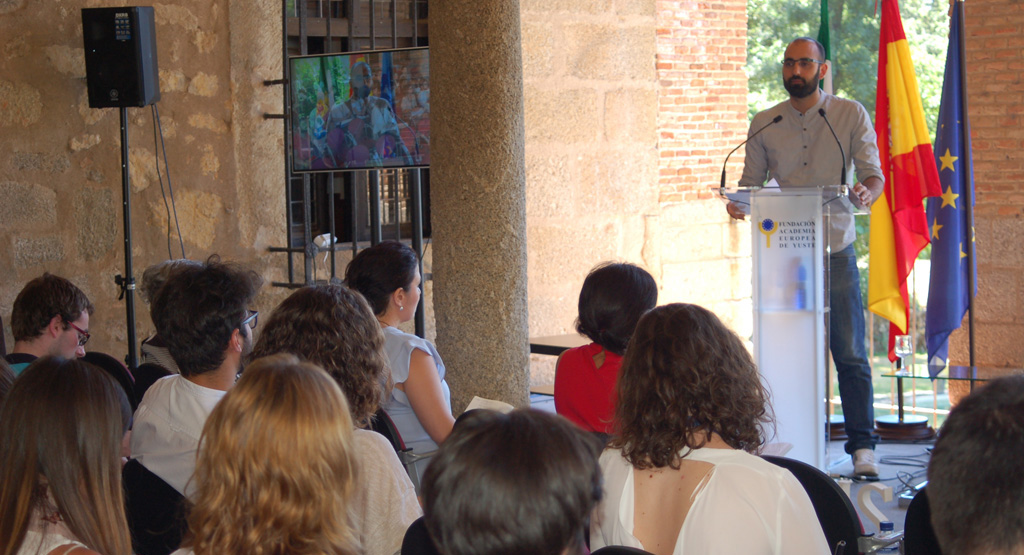
 José Ángel Calle Suárez, Director of the of Agencia Extremeña de Cooperación Internacional para el Desarrollo (AEXCID) (Extremadura International Cooperation Agency for Development Extremaduran) took part in today’s course, ‘Prospects, strategies and challenges of the European Union: conflict and safety threats in a global context’ with a focus on the refugee crisis and political transition. Rosa Balas Torres, Director General of Foreign Action for the Regional Government of Extremadura and President of the European Academy of Yuste Foundation’s Executive Committee gave the closing speech, in which she said the debate and reflection encouraged throughout the courses at Campus Yuste “makes for a stronger and better Europe”.
Calle explained how AEXCID develops either short, medium, or long-term action plans according to need, and remarked on the Extremaduran organisation’s usefulness as a “decentralised” body: that way it can work together with NGOs, responding immediately and effectively.
The AEXCID Director said the current humanitarian situation could not be described as “a refugee crisis” given that people are not being awarded refugee status as international law would grant them. Rather, it is a question of “people fleeing”.
She also explained that the United Nations model for new sustainable development objectives means cooperation needs to “break with its inwardly focussed habits and shift to a more universal, mainstream approach”.
At the same time, she understands that cooperation is a “social policy rather than a protective shield”, given that “it projects rights and projects democracy”.
Carlos Fernández Liesa, Professor of Public International Law from Madrid Carlos III University and Director of Francisco de Vitoria Institute for International and European Studies also took part in the morning session. He said how patently inefficient European Union Law is when it comes to refugees, asylum, and migration because member states “are divided, with some defending radical, xenophobic approaches”.
Discussing the EU-Turkey Agreement, the professor expressed his disapproval: “it goes against European values and doesn’t’t respect the 1967 Protocol relating to the Status of Refugees” adding that “it is not a formal agreement because it wasn’t passed by any government supervisory bodies”.
Cástor Díaz Barrado, Professor of Public International Law at Rey Juan Carlos University in Madrid and Director of Ibero-American Studies, addressed the question of regulation in terms of the migrants crises. He looked in-depth at the nature, content, and reach of the agreement between the European Union and Turkey. In his opinion, the agreement is “above all political, but legal in nature” because it doesn’t’t respect the agreements established by European Union treaties for implementing this type of agreement.
He sees the message as clear: “don’t come refugees” in spite of the fact that the agreement has been drawn up with detail to “avoid any interpretations contrary to the protection of human rights”.
The course is one of the University of Extremadura’s international summer courses with support from the Extremaduran Centre for Study and Cooperation with Ibero-America (CEXECI).
