


COMUNICACIÓN
THE INTERNATIONAL CONGRESS ON THE FRANCISCANS IN AMERICA HAS BEEN INAUGURATED IN GUADALUPE
News

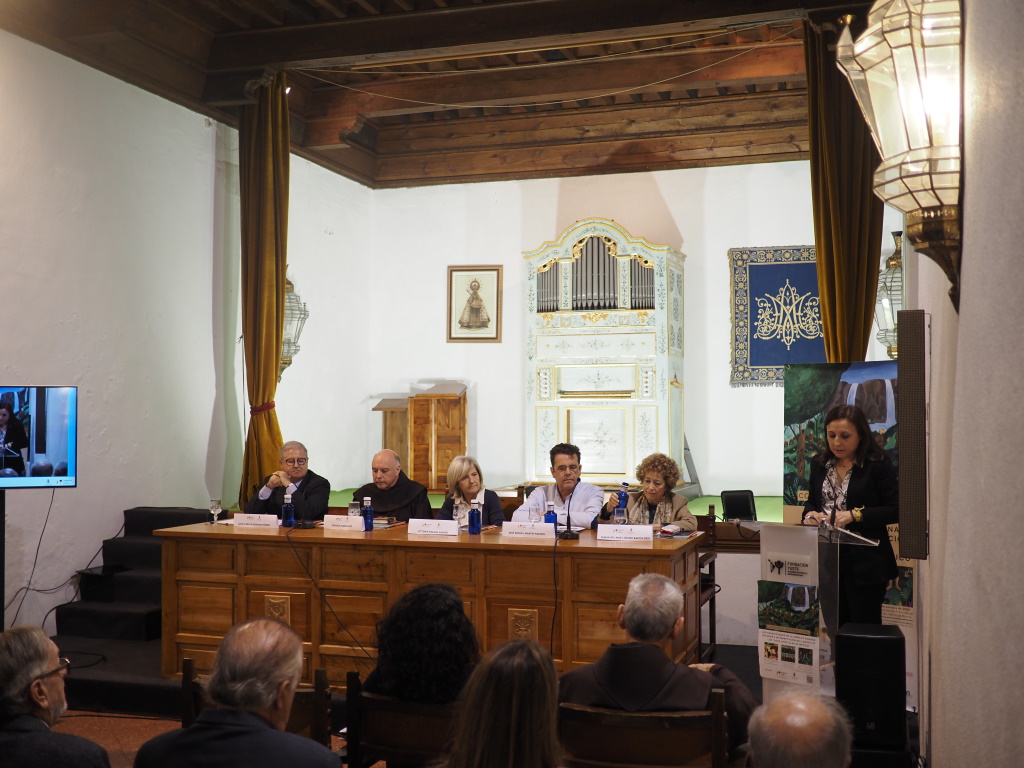 The “Twelve Apostles of Mexico” played a crucial role as cultural mediators, protecting indigenous peoples and promoting equality among native communities. (21/10/2024).
Reviewing and interpreting the role played by the Franciscans during the early stages of the evangelisation of America is the main topic of the International Congress that was inaugurated this morning at the Monastery of Guadalupe. The congress is dedicated to commemorating the fifth centenary of the arrival of the “Twelve Apostles of Mexico” at the port of Veracruz in 1524. These twelve Franciscans departed from the convent of Belvís de Monroy in Cáceres, sent by Charles V, and were welcomed by Hernán Cortés in New Spain. They soon became defenders of native rights, protecting indigenous peoples and promoting equality among native communities.
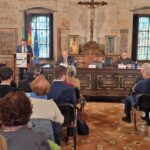
The inauguration of the Congress was well-attended, with participants coming from various parts of the peninsula. Representing the president of the Regional Government of Extremadura, the event was attended by Victoria Bazaga, the regional minister of Culture, as well as representatives from the European and Ibero-American Academy of Yuste Foundation and the Royal Academy of Extremadura of Letters and Arts, as the organising entities. The academic sessions are being held at the Royal Monastery of Guadalupe and the former convent of San Francisco in Cáceres, with the event concluding on Saturday 26th in Belvís de Monroy.
The programme includes speeches given by experts from universities in Mexico, the United States, Italy, and Spain. They will address topics that are not only related to evangelisation but also the cultural, anthropological, social, and political impacts of the Franciscan missionary activity.
During the opening session, Juan Carlos Moreno, director of Yuste Foundation, spoke, stating that organising this Congress was “an ethical and just imperative” because it recognises the “merit, courage, and evangelical commitment” of the twelve Franciscans who arrived in Mexico to “share the only wealth they had: peace and goodwill”. Also speaking were Joaquín Zurera Ribó, provincial minister of the Order of Friars Minor; María del Mar Lozano Bartolozzi, director of the Royal Academy of Extremadura of Letters and Arts (RAEX); José Miguel Martín Ramiro, mayor of Guadalupe; and María Victoria Bazaga, the regional minister of Culture, Tourism, Youth, and Sports. Bazaga emphasised that the government of Extremadura “looks towards America without reservations, as our strategy with Hispanic America is to work hand in hand because we share a common history”.
All the speakers highlighted the importance of the legacy of the Twelve Apostles of Mexico, pioneers in the spread of Christianity and staunch defenders of respect for the rights of native Americans. In the opening session, the participants praised the humanising mission of the Franciscans, which continues to serve as a guiding principle for policies on human rights in Ibero-America.
During one of the presentations on the first day, John F. Chuchiak, a professor at Missouri State University (USA), analysed one of the most remarkable aspects of Franciscan activity in New Spain. He pointed out how Franciscan missions became meeting points between European colonisers and local communities. The missions, he explained, were not only centres of evangelisation but also spaces where beliefs, practices, and knowledge systems were exchanged and negotiated. The Franciscan friars played a crucial role as cultural mediators, adapting Christian teachings to local worldviews and traditions, while also introducing new social structures and practices.
Additionally, Pilar Panero García, a professor at the University of Valladolid, discussed the linguistic and cultural challenges faced by the early Franciscans and how they found creative and practical solutions to fulfil their mission. They learned native languages, thus contributing to their preservation and dissemination.
The Congress programme includes a special concert on Friday, 25th October, at the Co-Cathedral of Cáceres entitled “Music and Evangelisation in the Spanish Viceroyalties”. This concert will, for the first time, present a repertoire of music used by the missionaries in their evangelising efforts in America.
