


COMUNICACIÓN
Yuste Foundation and the Economic and Social Council of Spain Underscore the Importance of Dialogue and Consensus in Consolidating European Values
News




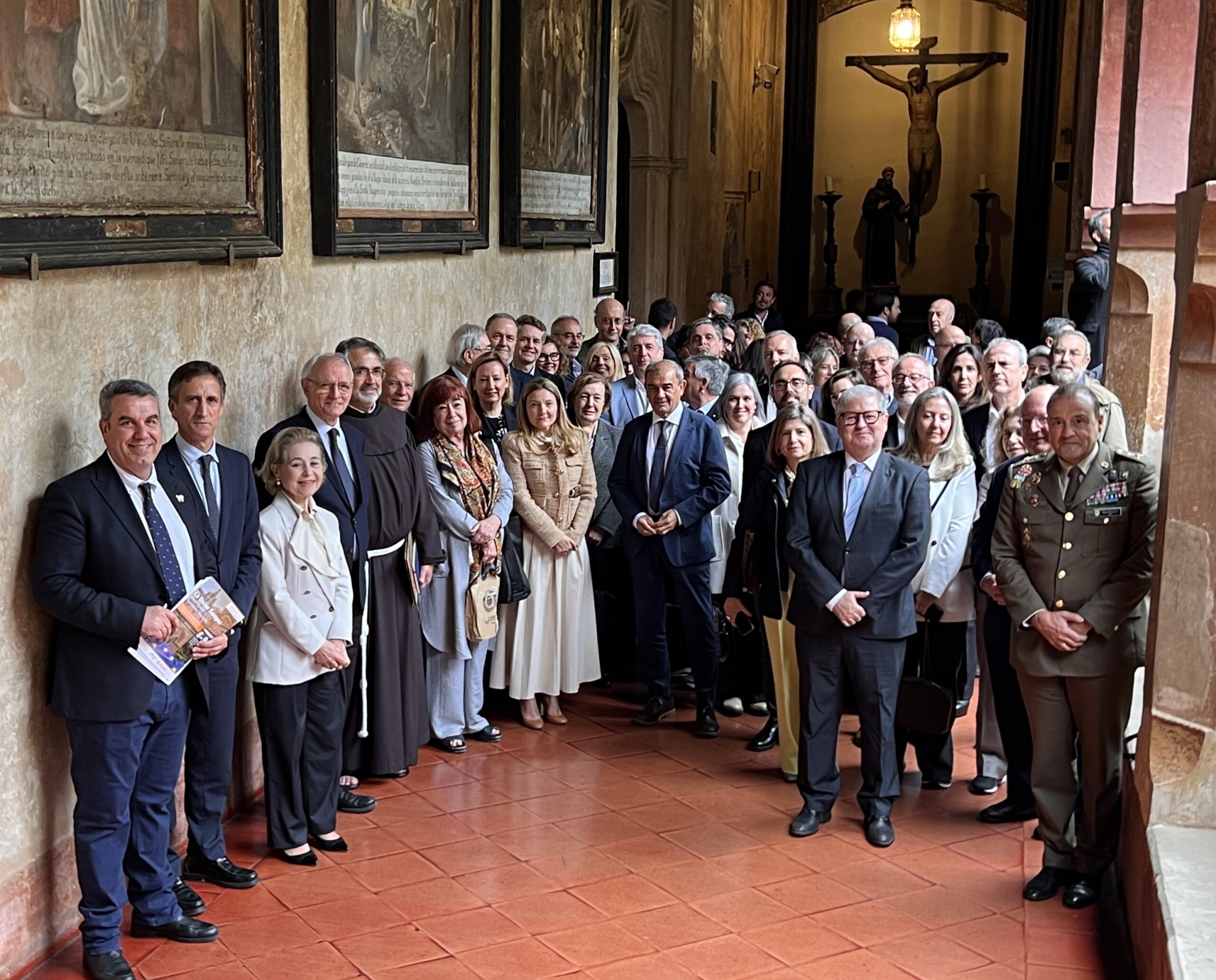 Yuste Foundation, together with the Economic and Social Council of Spain (CES), has organised the seminar “The European Union in the New Global Context: Improving Competitiveness by Advancing the Social Model”, which will take place today and tomorrow at the Royal Monastery of Santa María de Guadalupe, with the participation of around 80 CES members, a body composed of trade union organisations, the business sector, and experts appointed by the government. (09/04/2026)
During the opening session, the acting regional minister for Education, Science and Vocational Training, María Mercedes Vaquera, spoke and stressed the importance of “dialogue” in order to seek the “necessary consensus” to consolidate Europe’s core values, namely “democracy, the rule of law and freedom”.
The acting regional minister highlighted the “usefulness” of the CES in addressing the challenges facing Europe, noting that since its creation in 1958, it “has had the vocation of building bridges between decision-makers, something that is now more necessary than ever”. In this regard, Vaquera explained that in order to respond to the various circumstances, the Economic and Social Council must overcome challenges relating to “representativeness, effectiveness, visibility, and autonomy and technical capacity”.
In conclusion, Mercedes Vaquera also highlighted the work carried out by Yuste Foundation, as well as the role of Extremadura as a bridge with the Americas, “with whom we share an extraordinary human and historical connection”, and as a “meeting place”. In this regard, she referred to Guadalupe as a “nerve centre which, from the outset, has known how to build bridges between different disciplines and bring together advances in knowledge”, she stated.
The president of the Economic and Social Council of Spain, Antón Costas, explained that the aim of holding these seminars is to become “instruments of voice to convey the results of dialogue to society as a whole”. In this respect, he added that in recent years there has also been an effort to incorporate “listening to individuals who represent initiatives and actions of great importance, which we must be aware of in order to shape our views, which will later become the CES’s agreed reports and opinions to be conveyed to the government and society”.
In Costas’s view, the year 2020 marked the starting point of a new era with two distinguishing features compared to the previous one. “We have moved from the idea that globalisation is about supplying goods and services to consumer citizens at the lowest possible cost, to an awareness that citizens are not only consumers but also producers, that is, we have introduced the worker’s perspective, the industrial policy”.
For his part, the guardian and custodian of the Royal Monastery of Santa María de Guadalupe, friar Vidal Rodríguez, stated that, in his view, competitiveness is necessary, but only insofar as it entails “achieving higher levels of respect for and promotion of the individual and their rights”, and ensures bonds of collaboration and cooperation that “facilitate personal encounters, exchange, and social enrichment”, he said. The seminar will address topics such as defence in the European Union; competitiveness and innovation; and the social model.
Among the speakers are the president of CIDOB and former High Representative of the Union for Foreign Affairs and Security Policy and vice-president of the European Commission, Josep Borrell; the director of the Spanish Institute for Strategic Studies, brigadier general Víctor Bados Nieto; the professor of Economics and Business Organisation at the University of Zaragoza, Silvia Vicente-Oliva; and the director of CES Spain and director of the seminar, Carmen Vidal.
Yuste Foundation
It is a public, non-profit entity of a cultural, scientific, research, and outreach nature, forming part of the public foundation sector of the Regional Government of Extremadura. Among its objectives is contributing to the promotion and consolidation of the links between Extremadura, Europe, and Ibero-America, based on the principles of loyalty, respect for each other’s identity, mutual benefit, and solidarity.
It also supports the promotion of democracy, respect for human rights, the fostering of peace and international harmony, as well as the development of all the peoples and nations of the world, through the promotion of culture, research, the dissemination of knowledge, and social integration.
Economic and Social Council of Spain
The CES is the Government’s highest consultative body in socio-economic and labour matters, created by Law 21/1991. It acts as a forum for dialogue between trade unions, business organisations, and other sectors in order to analyse and issue opinions on government policies, with functional autonomy and attached to the Ministry of Labour.
Its functions include issuing mandatory reports on draft legislation and draft royal decrees regulating socio-economic and labour matters; producing optional reports; and preparing annual reports on the economic, labour, and social situation in Spain.
