


COMUNICACIÓN
Campus Yuste Examines the Future of EU–Latin America and Caribbean Relations in a New Global Context
News


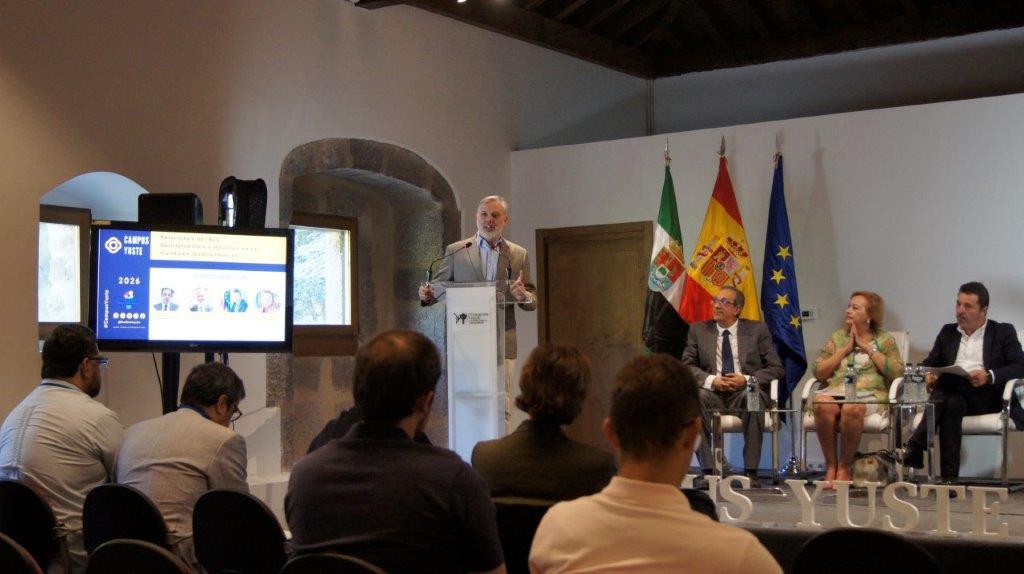
“Europe and Latin America and the Caribbean face both the challenge and the tremendous opportunity of preserving their historic relationship while working together to develop responses to an increasingly complex world”. These were the words of Pablo Hurtado, director-general for European Affairs and External Action of the Regional Government of Extremadura, at the opening of the course “UE–LAC Relations: Opportunities and Challenges in a Transforming World”, which is being held until Friday at the Monastery of San Jerónimo de Yuste, “a site of European memory from which Yuste Foundation promotes dialogue, reflection and exchange between Europe and Ibero-America”. (08/07/2026)
According to Hurtado, the two regions are looking towards a shared future founded on “knowledge, innovation, university cooperation, culture, science and opportunities for our societies”. In this context, he expressed Extremadura’s commitment to continuing to serve as a bridge through Campus Yuste, “a forum for calmly reflecting on the major shared challenges we must confront”.
At a time of profound transformation, marked by the war in Ukraine, instability in the Middle East, the energy transition and the technological revolution, the director-general called for “Europe’s strategic autonomy without relinquishing the defence of freedom, democracy, the rule of law, human rights, multilateralism and peace”.
For his part, Fernando Pizarro, director of the European and Ibero-American Academy of Yuste Foundation, recalled that the Campus Yuste programme forms part of the University of Extremadura’s Summer/Autumn Courses, “the essential framework that provides the academic basis for organising this gathering”, he said.
Fernando Pizarro highlighted the value of these summer courses, noting that they offer students “the opportunity to reflect and broaden the horizons of reason and truth”. Around 130 participants from countries including Belgium, China, Colombia, Cuba, Czechia, Ecuador, El Salvador, Germany, Honduras, Mexico, Morocco, Paraguay, Peru, Portugal, Spain, the United States, Uruguay and Venezuela have registered to attend the second course, either in person or online.
In closing, the director of Yuste Foundation explained that the fundamental purpose of taking part in Campus Yuste is to ensure that “debate and reflection grounded in freedom continue beyond these walls, so that we are able to build peace and a better society, never losing sight of the defence of human rights, the welfare state and lasting peace founded on truth and freedom”.
The opening session also featured Juan Manuel Rodríguez Barrigón, professor of Public International Law and International Relations at the University of Extremadura and director of the course, who placed the course theme in context by explaining that, in light of the continuing crises, realignments and tensions affecting transatlantic relations, “the European Union must give more serious and sustained consideration to the deep and strategic ties it shares with Latin America and the Caribbean”.
In this regard, Barrigón stressed the need for these relations to be underpinned by objectives that go beyond narrow national interests. “Both the European Union and the American states must commit themselves to giving their relationship a robust strategic dimension”, he stated.
Bringing the opening session to a close, the University of Extremadura’s vice-rector for University Extension, Teresa Terrón, underlined the timeliness of the course in the current political landscape. “We are living through a period of profound transformation. A geopolitical shift is shaping our lives. There are major energy challenges, new trade dynamics, and all of this is generating tensions that give rise to international conflicts and are redefining the global order. We cannot remain indifferent to these developments”. In this context, she added, “the relationship between the European Union, Latin America and the Caribbean takes on renewed significance”.
The course has been conceived as a forum for strategic reflection and open dialogue bringing together young people, academics, public institutions and civil society. It aims to examine the present and future of relations between the European Union and Latin America and the Caribbean from a multidisciplinary and intergenerational perspective, with the goal of generating new ideas, promoting public policy proposals, and contributing to stronger bi-regional cooperation capable of addressing today’s major global challenges.
The course forms part of the activities of the project “Cooperación UE–ALC en un Mundo en Transformación: Fortalecimiento Institucional para la Gobernanza Global” (EU–LAC Cooperation in a Translforming World: Institutional Strengthening for Global Governance), which seeks to reinforce institutional capacities, foster bi-regional political dialogue, and strengthen strategic cooperation between the European Union (EU) and Latin America and the Caribbean (LAC) in response to an international landscape shaped by profound economic, social, technological and geopolitical change.
