


COMUNICACIÓN
Extremadura Strengthens Its Role as a Bridge between Europe and Ibero-America at an International Congress Organised by Yuste Foundation in Chile
News
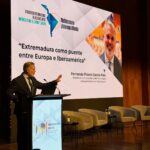



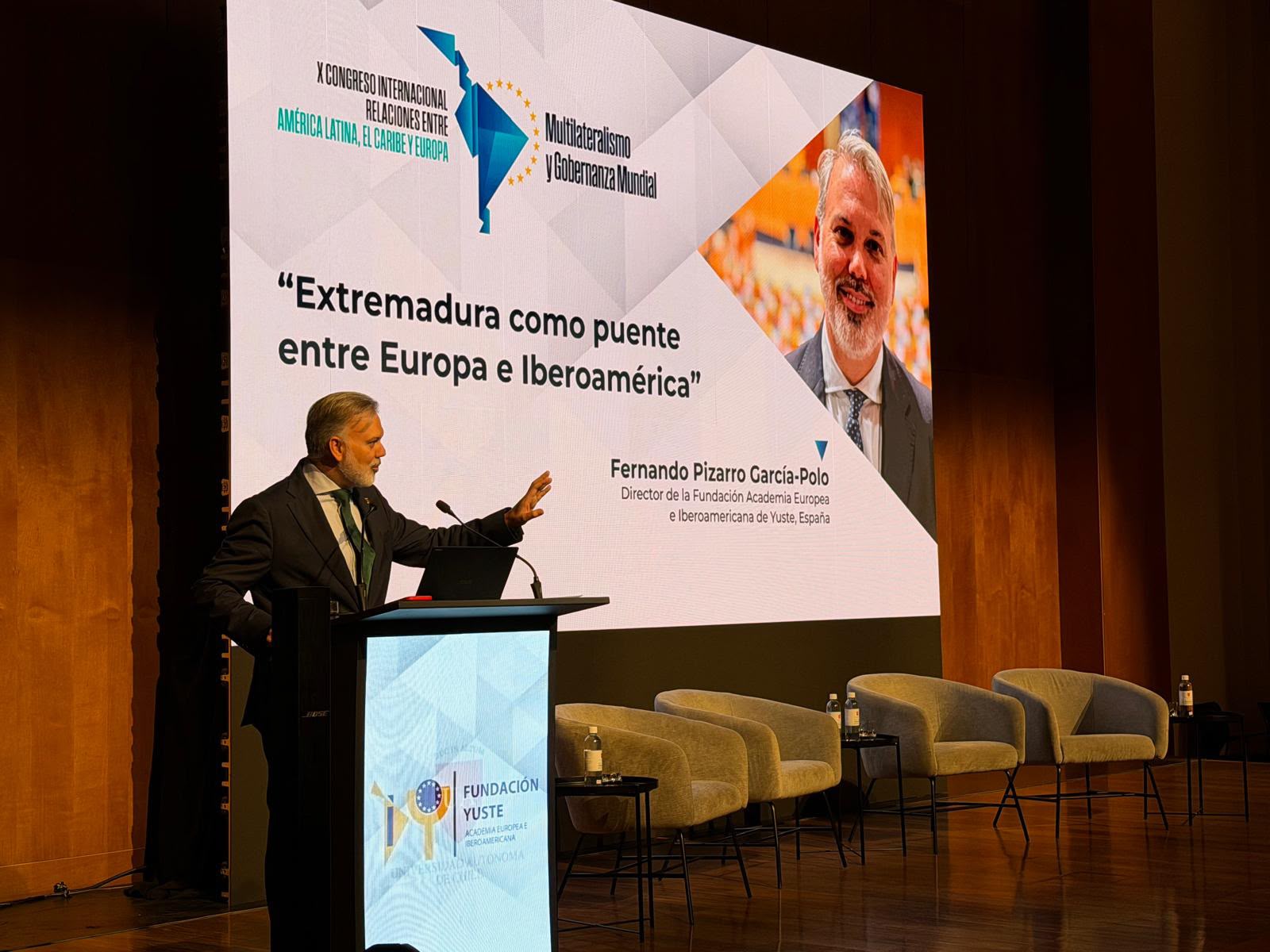
The event, organised in collaboration with Universidad Autónoma de Chile, brought together international authorities, diplomats and experts to analyse the challenges facing multilateralism, democracy and global governance. (04/11/2026)
The European and Ibero-American Academy of Yuste Foundation and Universidad Autónoma de Chile held the 10th International Congress on Relations between Latin America, the Caribbean and Europe in Santiago, Chile, on 27 and 28 October, under the title “Multilateralism and Global Governance”. The event brought together authorities, diplomats, academics and international experts to reflect on the challenges posed by the current geopolitical landscape and the need to strengthen cooperation and dialogue between the two regions.
The congress, held for the first time in this Ibero-American country, featured the participation of Chilean minister of Foreign Affairs Francisco Pérez Mackenna; former secretary general of the Organization of American States (OAS), José Miguel Insulza; rector of Universidad Autónoma de Chile, Teodoro Ribera Neumann; and director of Yuste Foundation, Fernando Pizarro García-Polo, among other experts and institutional representatives.
During his speech, Fernando Pizarro addressed Extremadura’s role as a bridge between Europe and Ibero-America, highlighting the importance of the historical, cultural and academic ties that connect both regions. He also emphasised “the contribution of the autonomous community to strengthening these relations through knowledge and international cooperation”.
Pizarro also highlighted the role of universities as meeting places and spaces for reflection in addressing shared challenges. “To discuss the world order, dialogue, and the good friendship and fraternity between countries, a place where these issues can be reflected upon is necessary”, he noted.
For his part, the Chilean minister stressed the need to strengthen cooperation between Europe and Latin America. “Europe and Latin America share a history spanning centuries. We are called upon to solve problems together; we share values. And what is important is that these kinds of initiatives help bring us closer together”, he stated.
To conclude, the rector highlighted the importance of promoting spaces for international reflection that make it possible to understand changes in the global landscape and strengthen university education. “Bringing people from Europe, who experience a different reality, together with people from Latin America makes it possible to draw conclusions, reflect and generate input for future decision-making”, he noted, emphasising the value of internationalisation for the university community.
Experts including Sagrario Morán Blanco, from the Rey Juan Carlos University; Iván Garzón Vallejo, a researcher at Universidad Autónoma de Chile; and Andrés Dockendorff, from the Institute of International Studies at Universidad de Chile, took part in the debates in a panel moderated by Aldo Cassinelli, director of the host university’s School of Government.
The presentations made it possible to address, from different academic and institutional perspectives, the challenges facing international cooperation mechanisms in a context characterised by geopolitical tensions, shifts in the global balance of power and the need to promote joint responses between regions.
The discussions on the second day focused on the challenges facing the democratic principle in Latin America, the continuity and effectiveness of multilateral mechanisms, and the implications of the development of artificial intelligence for democracy and international relations.
Participants included former secretary general of the Organization of American States (OAS), José Miguel Insulza; Cástor Díaz Barrado, academic at the Rey Juan Carlos University; Roberto Cippitani, from the University of Perugia; and Alejandro Amigo Tossi, researcher at Athena Lab, in a panel moderated by Sebastián Bozzo Hauri, dean of the Faculty of Law at Universidad Autónoma de Chile.
The event highlighted the value of collaboration between universities, research centres and public institutions as a means of promoting shared knowledge and strengthening ties between the two regions.
The congress is part of Yuste Foundation’s School of Guadalupe and the project “Cooperación UE-ALC en un mundo en transformación: fortalecimiento institucional para la gobernanza global” (EU-LAC Cooperation in a Changing World: Institutional Strengthening for Global Governance), funded by the Extremaduran Agency for International Development Cooperation (AEXCID). It also received support from the Regional Government of Extremadura, the Rey Juan Carlos University, through its Centre for Research in Ibero-American Studies, the University of Extremadura and the International University of Extremadura (UNINDE).
