


COMUNICACIÓN
AN INTERNATIONAL CONGRESS ANALYSES THE LEGACY OF THE “TWELVE APOSTLES OF MEXICO” AS A PROTOTYPE OF SPAIN’S HERITAGE IN AMERICA
News



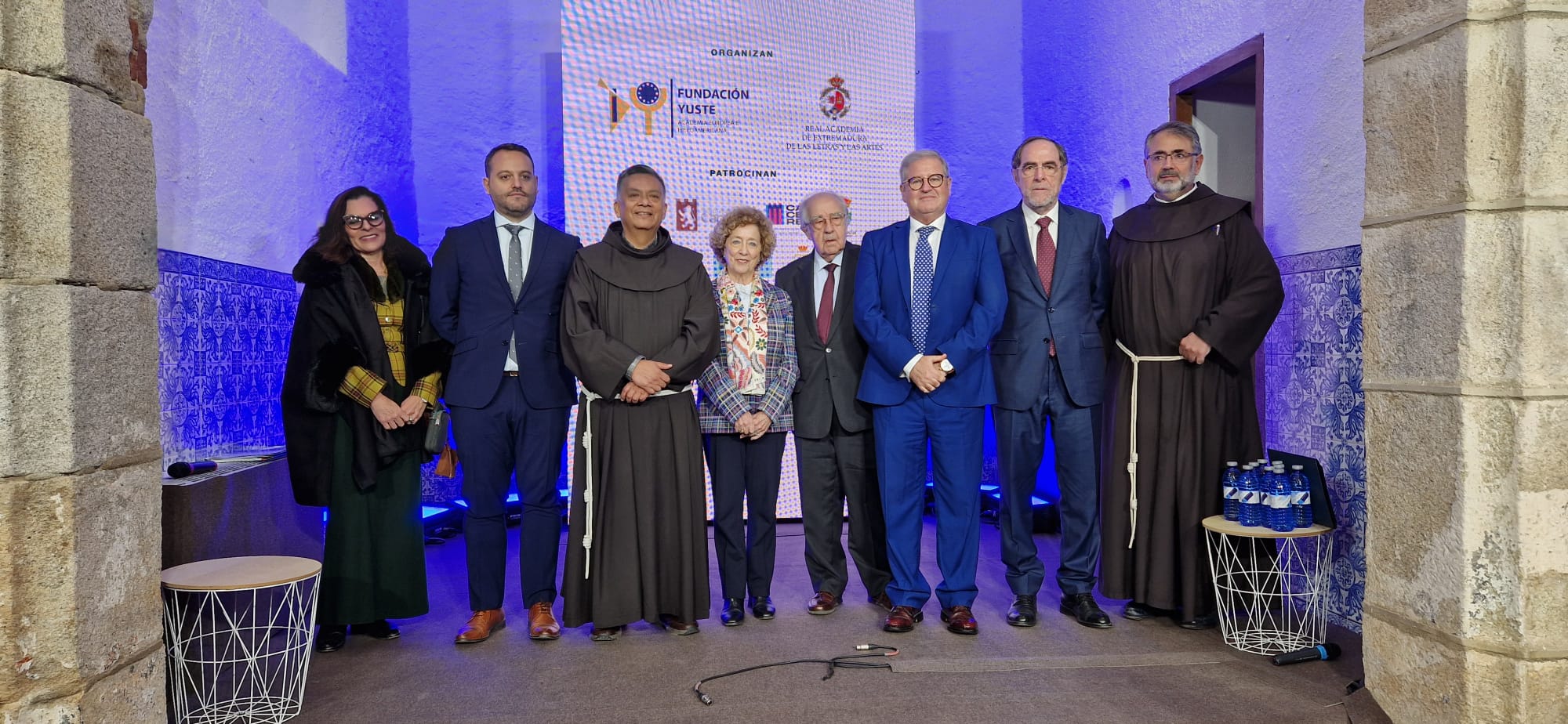 Academics, experts, and specialists from Spain, Italy, and Mexico gathered for four days at a scientific and academic congress aimed at interpreting and uncovering the legacy of the so-called “Twelve Apostles of Mexico” in today’s society. These intellectuals, brought together by the European and Ibero-American Academy of Yuste Foundation and the Royal Academy of Extremadura for Arts and Letters, sought to highlight through presentations and discussions the humanistic, social, political, cultural, and religious contributions of the twelve Franciscan monks who traveled from the convent of Belvís de Monroy to Mexico, leaving a lasting impact as a model of Spain’s best heritage in America. (26/10/2024).
This Congress, with over 350 registered attendees, was held in Guadalupe, Cáceres, and Belvís de Monroy, commemorating the date when twelve barefoot Franciscan men arrived in New Spain, carrying the banner of poverty with a calm vision and freedom of thought, understanding history as a process of advancement and progress.
In today’s closing ceremony at the San Francisco del Berrocal convent in Belvís de Monroy —the very place where twelve Franciscan friars set off for New Spain in 1524—Belvís mayor Fernando Sánchez advocated for the convent to become a vibrant space hosting activities that foster ties across the Atlantic.
For the director of Yuste Foundation, Juan Carlos Moreno, the congress has helped to publicly acknowledge Spain’s role in America, “with its errors and excesses, but also with its successes, among them being carriers of the evangelical message”. In this regard, he referred to the Franciscans’ work as protectors of native communities and their rights against the abuses of those in power.
The director of the Royal Academy of Arts and Sciences, María del Mar Lozano, expressed her satisfaction with the excellent attendance and the content presented, which will soon be published in a book.
The secretary-general of Culture of the Regional Government of Extremadura, Francisco José Palomino, thanked the organising institutions for holding the congress and affirmed that the convent will continue to thrive.
During the sessions, tribute was paid to those who, in 1986, brought the twelve Franciscan friars who departed from the convent of Belvís de Monroy out of obscurity in Extremadura. Among them were Antonio Montero, the first archbishop of Extremadura, and Juan Carlos Rodríguez Ibarra, former president of the Regional Government of Extremadura and promoter of the convent’s restoration, among others.
Throughout the congress, the role of religious figures as cultural mediators was highlighted, alongside the function of Franciscan missions as centres of evangelisation and meeting points between European colonisers and Mesoamerican indigenous communities. The Franciscans’ interest in the political and social affairs of the New Spain viceroyalty was also underscored, particularly through an analysis of the correspondence between the Spanish crown and “the Twelve.” Additionally, Hernán Cortés’s preference for the Franciscan order as a means to understand society in the Mexican territory was noted, with emphasis on the monks’ humanitarian approach in fostering closer ties, protection, and integration for indigenous populations subjected to abuses and extortion by the authorities.
The congress provided an opportunity to update recent research on the significance of Franciscanism in Extremadura during the latter half of the 16th century, as many of the first Franciscans in Mexico were from Extremadura and carried fundamental characteristics to America: evangelical poverty and, particularly from 1492 onwards, an evangelical fervour that they had already demonstrated both in newly conquered Granada and in Extremadura, whose population faced adversity. All presentations and papers will be compiled into a book.
