


ACTIVIDADES
EMPEROR’S MUSIC CONCERTS – CORO AMADEUS DE PUEBLA DE LA CALZADA
Monastery of San Jerónimo de Yuste, 19 September 2026
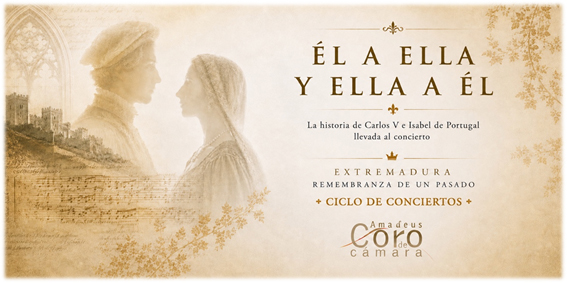
The programme presented by the Coro Amadeus de Puebla de la Calzada offers different listening perspectives with the aim of commemorating the 500th anniversary of the marriage of Charles I (Prinsenhof, 1500 – Monastery of Yuste, 1558) and Isabella of Portugal (Lisbon, 1503 – Toledo, 1539). These programme notes seek to guide listeners and highlight information, interpretations, and aspects that may enrich the concert experience.
Blending fiction and historical reality, the distinguished figure of Miguel de Cervantes, portrayed by an actor, will, through his characteristic prose, recount the story of Charles and Isabella in four stages of their lives. Rather than following a conventional chronological approach based on facts, dates, and music corresponding to each period, these stages focus on the love story that we can infer and perceive from contemporary documents and testimonies.
Our programme is therefore structured around music that expresses universal affections (affetti) transcending the historical stature of its protagonists: (1) the emotions of first love; (2) those of adulthood; (3) destiny and the loss of a loved one; and (4) the final years; memory and reflection. Each section concludes with a brief sacred epilogue that provides moral balance and spiritual resolution to its theme. Thus, the excesses of youth end in repentance (Peccantem me quotidie); the labours of daily life, in admiration (O gloriosa Domina); the workings of fate, in faith (In manus tuas); and mature reflection, in remembrance, gratitude, and hope (Pulchra es).
Religious Background
A second perspective highlights the importance of the Catholic faith and the values that helped shape what are now Spain, Europe, and Hispanic America. Through a number of chants, the programme reflects this legacy while underscoring the significance of the Hieronymite Order in Extremadura and how, through royal patronage, it fostered a remarkable humanist flourishing documented in the monasteries of Yuste and Guadalupe. These religious centres enhanced their liturgies, Masses, and ceremonies with music of exceptional artistic quality, which today continues to be studied and remembered.
In this regard, it is worth noting that the three introductory monophonic chants in the opening sections all come from the collection of choir books preserved at the Monastery of Yuste (Requiem aeternam from E-CUYm/Cant 1, the antiphon Magno Hieronimo, and the hymn Nunc sanctae nostra from E-CUYm/Cant 24, respectively). Likewise, the responsory In manus tuas by Fray Melchor de Montemayor, transcribed from the musical holdings of the Monastery of Guadalupe, bears witness both to the musical legacy that the Hieronymite Order left in our region and to the tribute this programme pays to the new Holy Jubilee Year of Guadalupe.
Other Considerations
Having explained the reasons behind the structure and overall concept of the programme, we now turn to other aspects of the repertoire.
The sacred polyphonic works that conclude each section (and open the final one) serve a dual purpose. On the one hand, they establish a coherent chronological and stylistic progression; on the other, their increasingly rich harmonies and ornamentation reflect the growing majesty experienced by the protagonists of this commemoration throughout their lives. Following these principles, the first sections conclude by highlighting the importance of the Seville school during the first half of the 16th century through the works of Cristóbal de Morales and Pedro Fernández de Castilleja (regarded as a “master of masters”). Both composers may well have witnessed the marriage that this programme commemorates. The third section features an eight-part work by Melchor de Montemayor, which bridges the stile antico still preserved in the musical collection of the Monastery of Guadalupe with the transition to the early seventeenth-century Mannerist style. Finally, the last section gives pride of place to the polyphony of Giovanni Pierluigi da Palestrina, an outstanding musical figure whose technical mastery and stylistic influence transcended centuries, borders, and even Church councils.
The secular repertoire, meanwhile, deliberately extends beyond the chronological boundaries of the programme in order to strengthen its dramatic narrative. Alongside the celebrated “Mille regretz” —known as the “Emperor’s Song”— the programme includes works by Juan Vázquez as well as pieces drawn from several important songbooks, including those of Uppsala, Turin, and the Casanatense. Although some of these compositions are little known today, they make a vital contribution to the emotional narrative that the concert seeks to convey.
Finally, special mention should be made of the prominent place given to the Extremaduran composer Juan Vázquez in this programme. A verse from his villancico “En la fuente del rosel” inspired the title of the programme and forms the basis of the final contrafactum, created especially for this production. This newly written text transforms the original song into an evocation of Charles and Isabella, bringing the musical journey full circle by returning to its point of departure, now enriched by the experience of the concert itself.

